


- Delivery to all EU countries
- Safe packaging and quick delivery
- Brick and mortar store in Katowice, Poland
Game expansions
Stone Age: The Mammoth Herd (Stone Age)


Specs
Version
multilingual
This is an expansion. You need the following game to play:
Stone Age (Epoka Kamienia)
Product description
A mammoth herd passes by your village. You can tame these mammoths for help in building your village. But hurry up! Other tribes are on the way too!
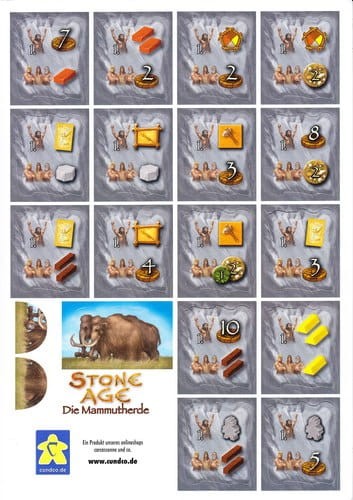
You can combine this mini-expansion with the base game as well as all the other expansions. First, you set up the game as usual. You shuffle all 16 bonus tokens and place them facedown next to the board. The standing Mammoth herd figurine is next to the pile. You are now ready to start the game. The game remains the same except for the following changes.
At the beginning of each round, the starting player places the mammoth herd on the resource shown by the highest bonus tile. For example, if the tile shows a brick, the starting player places a mammoth herd in a clay pit. Then he chooses the first bonus token and places it faceup next to the stack. The resources shown now are irrelevant for this round. If there are no bonus tiles left, the entire herd is tamed. In this case, you remove the mammoth herd and continue playing as normal. You put your people in as usual. Only in the phase where you benefit from the actions of your people does the mammoth herd become important. When you have people placed in a resource holding a herd of mammoths, you roll the dice as usual and take your resources. Immediately after that, you can move one or more people from the resource that contains the mammoth herd to the bonus tile that has been returned. You can try to tame the mammoth later to get help with your work. You can only move human figures from this resource production area, and you must immediately pay 1 token for each figure you place on the bonus tile. You can - as is the case with feeding - replace 1 food with 1 resource. Pawns that are not placed on the bonus tile must be returned to the player's board. After all players have benefited from their people's actions - but before feeding - you tamed 1 mammoth from the mammoth herd.
All players who moved people to the bonus tile roll dice. Each player uses as many dice as he has people on the bonus tile. All players roll the dice at the same time. Now you compare the score of your highest single die. You are not adding all the dice together as usual, and you are not allowed to use any tools. The player with the highest single die result wins and receives a "1". bonuses. He can also take the "everything" bonus. The winner then takes the tile and places it facedown in front of them. The reverse is not for the player, it only serves as a reminder of the final scoring. When the highest dice scores are level, the players compare the next lowest dice, and so on.
If there is still a tie after comparing all scores, all participating players receive the "all" bonus.
The plate should be put back in the box. If no one has placed a character on the bonus tile, no one will get the bonus. The plate should also be put in the box. Before you get civilization cards, you are dealing with mammoths. The player with the most chips gets 10 points. In the event of a tie, all participating players receive these points.
Producer

Related products
View full version of the site