


- Delivery to all EU countries
- Safe packaging and quick delivery
- Brick and mortar store in Katowice, Poland
Family games
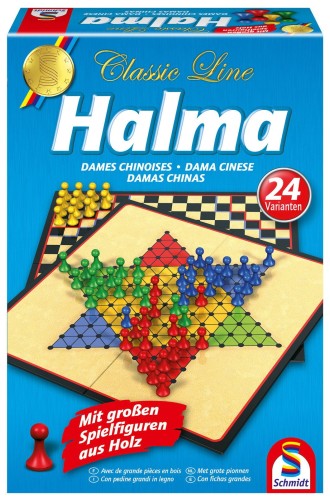
Halma (Classic Line)


Specs
Playing time
around 20 min
Rulebook language
polish, german, french, italian, dutch, spanish
Version
multilingual
Recommended age
from 8 years
Number of players
1-4
Game in English
No
Product description
Classic "Halma" is a game invented in 1883 or 1884 by the American George Howard Monks, played on a square board of 16x16 fields. In Poland, the name Halma was adopted for the version of this game played on a star-shaped board (in Lech Pijanowski's book "Przewodnik Gier" and in many other publications, this version of Halma is called "Trylma", another name is "Chińskie Warcaby", from the English name "Chinese Checkers").
Players make moves in clockwise order. Each player, on their turn, can move one of their pieces to an adjacent free square (in any direction). You can also jump over your own piece or the piece of one of your opponents, if there is a free space on the other side of the piece being jumped over. In one move, you can also jump over several of your own or opponents' pieces, if they are in a row. Jumped pieces are not captured. The winner is the player who is the first to place all of their pieces in the opposite corner of the star.
Note: The rulebook contains rules for the different versions of Halma (multiplayer and single player), played on both the star board and the checkerboard.
CONTENTS:
- Double-sided game board (diameter: 360x360 mm)
- 68 pieces (height: 27 mm)
- Instruction
Producer

Related products
View full version of the site